Monday, December 02, 2013

New Zealand Planning


There are many different ways to approach trip planning and we’ve tried several of them over the last ten years.

First there was our trip to Europe after college that consisted of us not planning. We’d get off the train in a new town and walk around until we found a suitable backpacker lodge for the evening. We’d ask the front desk for restaurant recommendations and our fellow travelers for activities in the area that they'd enjoyed. This fly-by-the-seat-of-your-pants approach can work really well in many parts of the world. It can also mean that you spend the night on the train station waiting room bench because all the hotel rooms are sold out. 

Then there was Peru which was also us not planning - we sourced everything out to a travel agent. There were a few reasons for this but it mainly had to do with Ben, who was 20 months old at the time. I wanted a tour guide’s local knowledge of child-friendly activities, a car to be waiting for us when we arrived at the airport, and hotels with cribs. Definitely the most expensive way, but so worth it in this particular situation. 

This trip was planned entirely by us. I spent many, many hours on TripAdvisor reading reviews and pouring over NZ guide books from the library. And in the end, we had a few hits and a few misses, not surprising, given our inexperience with the country. There is definitely an argument for using a travel agent: they’ve been to all the places they recommend and can weed out the winners from the losers. 

In the end, we made most of the car and hotel reservations in advance but waited until we’d set foot in the country to make activity plans. 

And then everything went onto the master spreadsheet. After my passport and credit card, this was the item that I least wanted to lose as it had all our travel details: flight info, hotel confirm numbers, drive times/directions, and activity recommendations. 

Here is an example of a daily entry. Click on photo for close-up.


First, an overview of the day’s plans. In this case, it was a big driving day: Going from Russell to Rotorua, with one hike to break things up around mid-day.


Followed by the driving distance, estimate of how long it would take to get there, and basic directions. 


Then the activity details, including a short description (and possibly a DOC website link):


And lastly, hotel information (including confirm #s, which have been removed here), costs, type of room, dates of reservation, etc:


We lived by this thing while traveling! We also found the NZ isites to be a great source for maps and tourist magazines with coupons. There were only a few tours in which we showed up without clipped discount vouchers in hand.

Hope that helps with your next trip. 

xo, 

Sonja


All New Zealand Posts: 

Part 1: New Zealand Travel Route: The North Island in 8 Days
Part 2: Auckland: the cosmopolitan heart of the North Island
Part 3: Waipoua Forest: giant trees and pretty views
Part 4: Bay of Islands: Swimming with Dolphins
Part 5: Karangahake Gorge: an abandoned gold mine in a stunningly beautiful valley
Part 6: Rotorua: The Yellowstone of New Zealand
Part 7: Tongariro and Whanganui National Parks: Two of the “Nine Great Walks of New Zealand”
Part 8: Waitomo: Glow Worms Galore! 

Sunday, December 01, 2013

Trips: Waitomo Caves, New Zealand


After Bay of Island and Rotorua, Waitomo was one of my favorite stops in New Zealand. We started off our adventure with the 1km  Ruakuri Walk - definitely a must-do tramp when visiting Waitomo.


There are caves, gorges, and fantastically structured limestone formations.


Then we joined SpellBound Tours (see info below) for an amazing two-cave trip.


Into the cave we go..

 Hard hat! Lights! Warm clothing! check, check, check.


We chose this tour because it didn’t require suiting up in a wetsuit and jumping off rocks. And it was known for the incredible glow-worm experience.


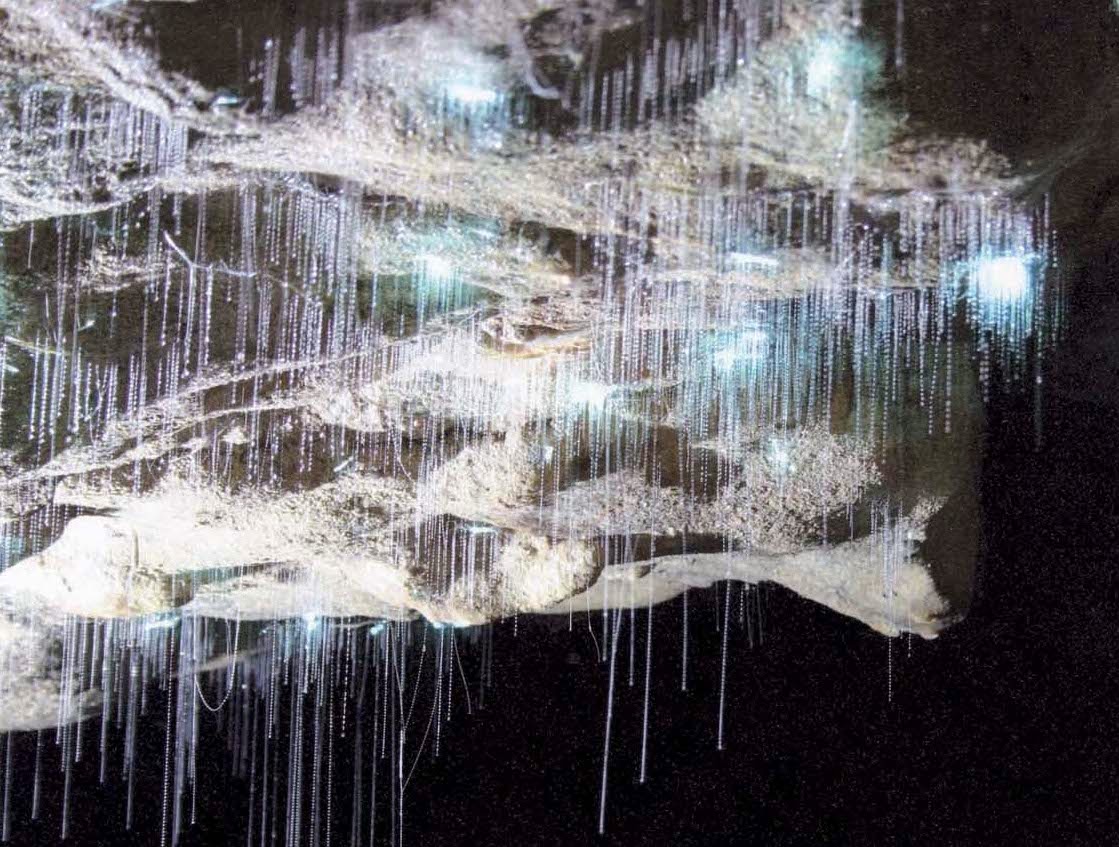
I tried my best to photograph the glow worms but it was a miserable failure. There are a few professional shots down at the bottom too, but they simply cannot convey how incredible it was to be in a cave lit entirely by biolumenessence.


Beginning the rafting portion of the cave experience.


Stalactites!

How do you tell the difference between stalactites and stalagmites? Stalagmites are ‘mighty’ because they have to grow up from the ground!


 Here are a few pro shots, courtesy of Spellbound:


The New Zealand glow-worm is one of the most interesting insects of the New Zealand fauna. It occurs throughout the country in limestone caves, unused mining tunnels, along stream banks, in damp bush-clad ravines, in damp shady crevices, and under tree-fern fronds in rain forests. The Glow-worm Grotto in Waitomo Cave has become world famous because of the tens of thousands of glow-worm larvae which live on the walls, ceilings, and stalactites of the grotto.

The New Zealand glowworm is a fly belonging to the gnat family. The larvae, pupae, and adults of both sexes are all luminous. In the larval stage the light attracts prey in the form of other organisms, while in the pupal and adult stages the light attracts the opposite sex.

[Sonja here: “Glow worm” has a nice ring to it, don’t you think? Much better than “Glow maggot”, which is, in fact, what they are]

The larva prepares a nest in the form of a tunnel of mucous and silk, and suspends from this an array of fishing lines composed of the same materials. Prey is snared in the long sticky fishing lines. The larva hauls up the fishing line on which the prey is entangled and consumes the trapped insect. Up to 70 lines are let down by one larva and, depending on the size of the larva, the lines vary in length from under 1 cm to 50 cm. Each fishing line consists of a long thread of silk which bears at regular intervals a series of mucous droplets giving the appearance of a string of beads. The droplet size is about 1 mm in diameter. Nests and lines can be reconstructed and repaired. Fully grown larvae measure up to 40 mm in length and adult flies average 15 mm in length. The life cycle appears to take 11–12 months, with the larval stage lasting eight or nine months. Breeding shows little evidence of being a seasonal phenomenon


By far the coolest part of the tour was getting into a raft and floating down an underground river that was lit entirely by glow worms. It was light enough to make out the features of the people sitting next to you. Truly spectacular!!!! Seriously, GO DO IT, if you’re ever in New Zealand.


Well, that’s a wrap on New Zealand. Thanks for coming along for the ride, Dear Readers.

xo,

Sonja

Up Next:


All New Zealand Posts: 

Part 1: New Zealand Travel Route: The North Island in 8 Days
Part 2: Auckland: the cosmopolitan heart of the North Island
Part 3: Waipoua Forest: giant trees and pretty views
Part 4: Bay of Islands: Swimming with Dolphins
Part 5: Karangahake Gorge: an abandoned gold mine in a stunningly beautiful valley
Part 6: Rotorua: The Yellowstone of New Zealand
Part 7: Tongariro and Whanganui National Parks: Two of the “Nine Great Walks of New Zealand”
Part 8: Waitomo: Glow Worms Galore! 


If You Go


Where to Stay

Waitomo Lodge Motel - Looks like a ho hum motel from the outside but it’s slick Scandinavian modern inside with great beds and a nice kitchenette (micro, fridge, and plates/cups/utensils). Big grocery store just up the road.  From $125 NZ/night. Just fifteen minutes from Waitomo.

What to Do

Ruakuri Walk - 1 km. This short walk is a ‘must do’ when visiting the Waitomo area. Includes caves and classic limestone outcrops in a pretty river gorge.

Spellbound Cave Tours - a smaller tour company than the regular outfits, you’ll skip the enormously overcrowded caves and enjoy an incredible underground experience, complete with a subterrarium boat ride and a glowing tunnel. Our group of 15 was perfectly suited to exploring two separate caves. Our guide Norm was excellent. Includes a short bush walk and tea/coffee/cocoa. Good for those that aren’t up for the getting wet or have some mobility issues (or are pregnant!).

What We Considered

The Legendary Black Water  Rafting Trip - from their website: The Legendary Black Water Rafting Company is New Zealand’s first black water rafting adventure operator. We’ve been sharing thrills and excitement since 1987, and have experienced guides who will take you safely through the stunning underworld of Ruakuri Cave. What began as a special treat for a brave few has developed into a spectacular tourism attraction that gives visitors of all ages the chance to abseil (rappel), weave, jump, climb, and float through a glowworm-studded subterranean wonderland at Waitomo Caves.

Friday, November 29, 2013

Trips: Tongariro and Whanganui National Parks, two of the “Nine Great Walks of New Zealand"


We headed south from Rotorua, prepared for a long day of driving. We needed to make Whanganui National Park, at the southwest end of the island by nightfall. 


We made a pit stop at Huka Falls:

The Waikato River, New Zealand's longest river, moves gracefully north from Lake Taupo between banks 100 metres apart. Just before the Huka Falls it enters a shallow ravine of hard volcanic rock. The effect is nature's large-scale equivalent of a fire hose feeding into a very fine nozzle.

The previously placid waters roar and rumble at great speed along the ravine before bursting into space out over Huka Falls to crash into the turbulent pool 11 metres below. A foot bridge right at the top of the falls puts you in a prime position to get up close and witness the frightening display of more than 220,000 litres of water blasting by every second.


From there, it was past the charming down of Taupo, along the lake, and south to Tongariro National Park (Whakapapa Village). It’s hard to tell in this photo, but one of those cloud puffs is actually a smoking column rising from the top of the mountain. We are in volcano country!


We stopped at the visitor’s center to bone up on regional history and take a short tramp along the ridge.


The visitor’s center is above 3,500 feet in elevation and the vegetation is strikingly different than the lush forests at sea level. 


Lord of the Rings Fans will recognize the non-CGI version of Mt. Doom (below):


From Tongariro, we continued south, eventually turning off the highway in Raethi and heading into the Whanganui National Park. This is a spectacular drive, which begins with very pretty pastures and a view of Tongariro in the distance. 


We quickly left the sheep and cows behind for the wild NZ forest. Whanganui is also listed as one of the “Great Walks” although in this case it’s a paddle down the river, not a tramp through the countryside. Two or three day canoe trips can be arranged with overnights in Department of Conservation huts along the way. 


This is definitely a trip you’ll want to do during daylight hours, both for the view and driving as the road is twisty, narrow, and perched above the steep gorge. It’s also unpaved for approximately 20km, although that may change in the coming year. 


At last! Our little cottage for the night. The only neighbors are the sheep next store. 


xo, 

Sonja


Up Next:


Part 8: Waitomo: Glow Worms Galore! 


All New Zealand Posts: 


Part 1: New Zealand Travel Route: The North Island in 8 Days
Part 2: Auckland: the cosmopolitan heart of the North Island
Part 3: Waipoua Forest: giant trees and pretty views
Part 4: Bay of Islands: Swimming with Dolphins
Part 5: Karangahake Gorge: an abandoned gold mine in a stunningly beautiful valley
Part 6: Rotorua: The Yellowstone of New Zealand
Part 7: Tongariro and Whanganui National Parks: Two of the “Nine Great Walks of New Zealand”
Part 8: Waitomo: Glow Worms Galore! 


If You Go


Places to Stay

Kohu Cottage 
Sleeping three people (one queen and one single), this tiny cottage in the equally tiny hamlet of Korintini is bare bones but comfy and equipped with a killer view. Full kitchen, linens, and tea supplies provided. Bring books and dvds because there aren’t many activities in the immediate vicinity. Also, the nearest store is 45 minutes away so stock up on groceries before heading out to the cabin. The owner, Lois, lives close by and is a charming host.


 A good-jumping off point for those wishing to do a jet boat tour. Also check out the Maori pa across the street. The cabin is well-signed and located on the Whanganuai Road, approximately 45 minutes north of the town of Whanganuai. At the time of this writing, it was $100 NZ for the first night, $80 NZ for each additional night. We had one mishap with the cottage that I’m a bit hesitant to write about as I’m sure that it’ll be rectified immediately: a family of possums had moved into the attic and we had quite an exciting night as they were hosting a jolly party above our heads. They quieted down in the morning but it lead to a rather sleep-less night on our part. Contact: Lois Gilbert: kohu.cottage@xtra.co.nz. No website. Here is the google street view.


Flying Fox Retreat
 This place looks fantastic and is close by to Kohu Cottage. At the time of this writing it was closed; in the event that it reopens in the future, it might be worth checking out. http://www.theflyingfox.co.nz/


Things to Do

Pipiriki to Whanganuai - This drive is considered one of the most scenic in the country and it’ll be even better once it’s fully paved. It follows the Whanganuai River as it twists and turns it’s way to the ocean. There aren’t many view points so make the most of the ones you spot along the way. Currently portions are unpaved and it’s a rough two hour trip.

Huka Falls - a nice place to stretch your legs, use the (pay) toilet, and admire the view. Just north of the town of Taupo.

Ridge Walk at Tongariro National Park - Go for as little or as long you’d like; the views are amazing once you leave the bush. Trail entrance just above the visitor’s center in Whakapapa Village. 


Additional Activities to Consider:

Jet Boat to the Bridge to Nowhere and Canoe Ride Back - Really wish we could have done this - but there are a number of rapids on the river and we ultimately decided that it wasn’t the best pregnant lady option

Tongariro Crossing: One of NZ’s 9 Great Walks, it’s an all-day, 17km tramp across stunningly barren scenery. http://www.newzealand.com/us/feature/tongariro-alpine-crossing/

Taranaki Falls: If a long alpine hike isn’t your thing, consider the 6km falls hike, leaving from the visitor’s center at Whakapapa Village.

Taupo: We were charmed by this little town by the lake. Wish we’d spent more than an hour exploring the shops and lake-based activities. As it was, we popped in to buy Ben an official All Blacks rugby ball and then continued south along the lake shore.

Trips: Rotorua, New Zealand


We spent two nights in Rotorua. There are many activities available in this lakeside town, ranging from zorbing (rolling down a hill in an inflatable ball) to sheep shearing. Prepare yourself for some serious sulfur smells though - there are odoriferous thermal pools throughout the entire area.

First Up: Rainbow Springs Wildlife Park with the optional kiwi nursery tour (which is definitely worth the extra $, by the way). We paired our tickets with an Agrodome sheep show. 


We like small zoos that specialize in local species and Rainbow Springs was exactly that; the Alaska Zoo is another great example of a wildlife park that has a focus on regional animals - especially those that are injured or orphaned. 


New Zealand is known for their kiwi birds, but also a ground-dwelling parrot called a Kea.


They also have an exhibit of the crazy-looking pre-historic tuarara. From the RS website: Tuatara are possibly one of the world’s most misunderstood creatures. Tuatara are neither dinosaurs or lizards, they are in fact the only remaining species of an otherwise extinct order of reptiles called rhynocephalids. Because all other species of the once plentiful rhynocephalids went extinct at about the same time as dinosaurs, tuatara are often incorrectly classed as living dinosaurs.


Randomly, the park also has an amusement ride, which Chris got to ride by himself (‘pregnancy’ was one of the banned medical conditions):


Next up: Our kiwi tour. The zoo is the site of the National Kiwi Trust, a non-profit dedicated to  introducing young kiwis back into their native habitat. 

Here is your kiwi tidbit for the day (from wiki): 

Kiwi are flightless birds endemic to NZ, in the genus Apteryx and family Apterygidae. At around the size of a domestic chicken, kiwi are by far the smallest living ratites and lay the largest egg in relation to their body size of any species of bird in the world. There are five recognised species, two of which are currently vulnerable, one of which is endangered, and one of which is critically endangered. All species have been negatively affected by historic deforestation but currently large areas of their forest habitat are well protected in reserves and national parks. At present, the greatest threat to their survival is predation by invasive mammalian predators.

The kiwi is a national symbol of New Zealand, and the association is so strong that the term Kiwi is used in some parts of the world as the colloquial demonym for New Zealanders.


Due to predation from introduced predators (possums, stoats, dogs, etc) and habitat destruction, only 5% of kiwis survive their first year of life. The Trust collects eggs from the wild and then rears the chicks at the center before releasing them back into their natural habitat as yearling birds, better able to defend themselves against predators and such.

This was definitely a must-do part of the park.  [side note: Can you tell that I cheated on the kiwi photos? No photography was allowed in the nursery so these are the stuffed versions that were on display in the museum].

Next up: The Agrodome!


 The Agrodom is a slick, highly commercialized sheep show. It was a hoot. You can’t go to New Zealand and not see sheep, so we felt obligated to learn a bit about the national wool industry. The show included a primer on each breed, a shearing demonstration, and some crazy sheep herding skills exhibited by the resident dogs.  


And they had lambs. Cute and tasty!


Downtown Rotorua is worth a walking tour, especially the park that is situated around the museum, as it comes complete with rose gardens, ponds, and natural hot springs.


Our favorite activity was the Wai O Tapu Geothermal Wonderland, about 25 minutes south of Rotorua. If you get there right at opening, you’ll likely have time to walk the entire loop before heading back to catch the daily eruption of Lady Knox Geyser, located near the visitor’s center.


The colors of the water were amazing. I was partly convinced that a whole lot of food coloring was being secretly added to the lakes. :)


Don’t forget Lake Ngakoro (#18)(shown above and below). It’s off the beaten path but definitely worth the five extra minutes of walking.


The Oyster Pool. 


And stinky, boiling cauldrons of mud (my explanation, not theirs):


Another perk of getting there at opening: the famous Champagne pool will be deserted:


Walking through clouds of foul-smelling steam. 


My very favorite: Devil’s Pool. Looks a bit like anti-freeze, yes?


Click here for a complete map of the park. 


Last but not least we headed back to the car for a brief drive to the Lady Knox Geyser. First discovered by loggers wanting to wash their clothes in the hot water, she erupted as they rinsed their soapy garments in the basin.

Evidently the surfactants break the surface water tension, allowing the built-up pressure to be released in the form of a 30-ft geyser. Or something along those lines. Regardless, the rangers come along everyday at 10:15 and pour a bunch of soap down the spout, causing the geyser to erupt. I’m of two minds about this practice, but  it was definitely an interesting little show. 


And that, my Dears, was our jaunt into Rotorua. 


xo, 

Sonja


Up Next:

Part 7: Tongariro and Whanganui National Parks: Two of the “Nine Great Walks of New Zealand”


All New Zealand Posts: 

Part 1: New Zealand Travel Route: The North Island in 8 Days
Part 2: Auckland: the cosmopolitan heart of the North Island
Part 3: Waipoua Forest: giant trees and pretty views
Part 4: Bay of Islands: Swimming with Dolphins
Part 5: Karangahake Gorge: an abandoned gold mine in a stunningly beautiful valley
Part 6: Rotorua: The Yellowstone of New Zealand
Part 7: Tongariro and Whanganui National Parks: Two of the “Nine Great Walks of New Zealand”
Part 8: Waitomo: Glow Worms Galore! 

If You Go:

Things to Do
Rainbow Springs Wildlife Park (look for coupons in the tourist mags or combine with Agrodome for slight discount)
Wai-O-Tapu Thermal Wonderland (coupons available)
Stroll through the Government Gardens (Free)

Things We Considered:
Zorbing! (I wanted to but didn’t think it was really an appropriate pregnant-lady activity)
Rotorua Museum and the Government Gardens
Maori Village and hangi (feast)
Visit a natural geothermal spa
Hobbiton - For those Lord of the Rings Fans out there. (outside of Rotorua)