Thursday, August 02, 2012

Weekend Activities

Peeps!

I hope you had a great weekend. 
We had a nice warm week which meant we spent lots of time trying to stay cool. 


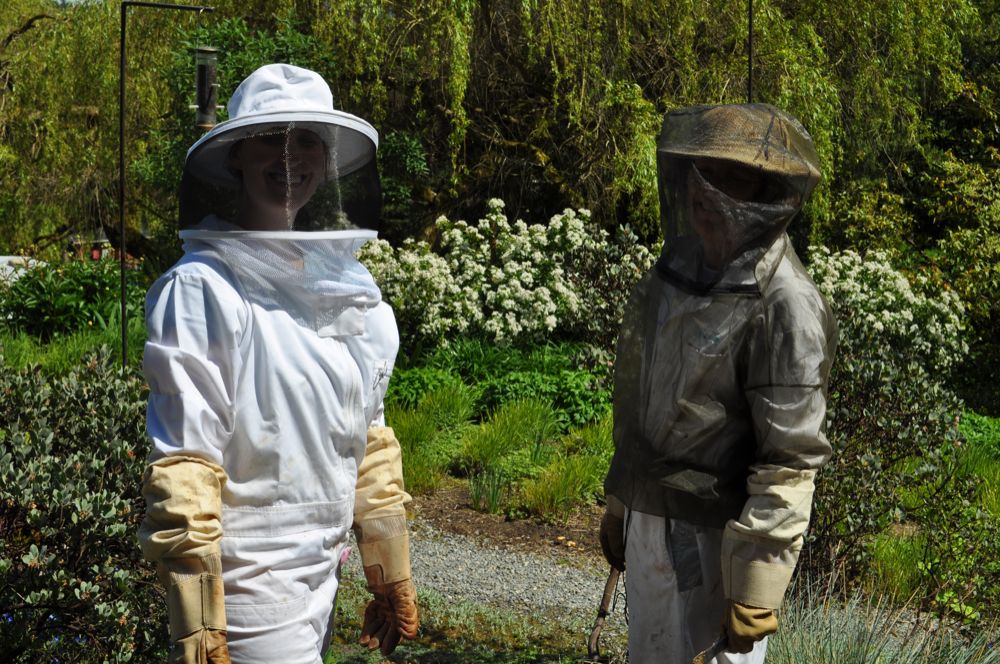
On saturday morning we started painting our shed and then I zipped over to my parent's house to check out the bees. The good news is that there is lots of honey. The really bad news is that the hive swarmed and took their sweet-as-a-peach queen with them. There were a few queen cells but no eggs or larvae - meaning that the new queen hasn't got up and running yet. Bad news, peeps. I wouldn't be surprised if the hive didn't make it through the winter. 

On Sunday we went for a hike with the bambino. 


Chris and Ben fixed their car:


And hung out around the house. 

And we took a trip to pay homage to the boys' swedish heritage:


It was a busy, busy weekend.


xxoo, 

Sonja

Thursday, July 26, 2012

Bees in the Blog-o-sphere

Heya Peeps,

There is a picture of our wee little hive on the HGTV gardens. Check out the article here.


Saturday, June 02, 2012

Beekeeping - Mite Control

Upon opening up our hive in April we noticed varroa mites on the bottom board and even saw a few clinging to the thoraxes of a few ladies. Unfortunately, most hives in the United States suffer from some level of mite infestation but a heavy load can several cripple or kill a colony. Populations of mites tend to increase over time, meaning that older hives can often have large numbers of blood-sucking vermin. 

Bad news. 
Here is a bit from wiki


Varroa destructor is an external parasitic mite that attacks honey bees Apis cerana and Apis mellifera. The disease caused by the mites is called varroatosis.Varroa destructor can only replicate in a honey bee colony. It attaches at the body of the bee and weakens the bee by sucking hemolymph. In this process RNA viruses such as the deformed wing virus (DWV) spread to bees. A significant mite infestation will lead to the death of a honey bee colony, usually in the late autumn through early spring. The Varroa mite is the parasite with the most pronounced economic impact on the beekeeping industry. It may be a contributing factor to colony collapse disorder (CCD), as research shows it is the main factor for collapsed colonies in OntarioCanada.[1]

There are a few ways to fight mite infestation but aside from throwing large amounts of insecticides at them, the other methods that are available to beekeepers are often aimed at simply controlling the mite populations, rather than eliminating them completely. 

For example, we use a screened bottom board on our hive, in the hopes that mites that fall off their host bee will slip through the hive bottom and end up on the earth, where we fervently hope they'll be consumed by ants or some other carnivorous bug. 

Other beekeepers will insert a short frame into their deep supers as honeybees are likely to use the empty space to raise drone (male) brood. For reasons I don't quite understand, mites prefer to lay their eggs alongside drone larvae (rather than female workers). 
Since drones in a hive with a strong, healthy queen are seen as expendable, beekeepers will periodically remove the short frame and stick it in the freezer, killing both drone larvae and mites. As I said, it's a way to control (not eliminate) mite populations. 


Another option that is thought to have some impact is a periodic dusting of sugar. Evidently sugar granules are approximately the size of a mite's foot pad. A foot covered in slippery sugar makes it difficult to hang on to one's host and mites tumble down onto the bottom board.

Sugar is harmless to the bees - in fact - it'll even serve as a small snack for the bee ladies. Experts differ on what type of sugar is best for mite control. Some suggest that regular cane sugar, ground with a coffee grinder into a super-fine size, is superior, however, powdered sugar is also widely employed to fight the wee little buggers.

 People also hypothesize that the application of the sugar causes the bees to spend more time cleaning themselves, which can often knock the mites off and onto the ground.

We can attest to this last bit: our girls immediately settled down to begin a grooming regimen.

I don't have any pictures of the mites. Next time we open up the hives, I'm going to try and snag a bee that has one. They are smaller than the head of a pin and are typically situated on the bee's broad thorax (right behind the head, between the wings).
 Both mom and I have remarked on numerous occasions that each colony has a distinct personality. Our first year we had a hive that was generally ornery and nasty. You could tell how pissed off they were by the level of their humming. Loud=not good.
This hive is the polar opposite. They are sweet and gentle and oh so very calm. That may change, depending on a few factors (honey levels, queen problems, etc) but right now they remain a pleasure to work with.

We'll keep you posted on the success of our sugar dusting operation.

xxoo,

Sonja

Wednesday, May 23, 2012

Hive Update - Coming Soon

I have some pictures to post of our little ladies but haven't the time currently. Mom and I did a huge hive project last weekend that involved several pounds of powdered sugar. 

It was a sweet mess :)

Here is one of our gals, brushing herself off. 


Tuesday, May 08, 2012

Beekeeping Update

It's been a while since we had a bee update. 

Here is the latest:
 This is a semi-feral hive, meaning that they lived in an old tree trunk before moving into our Blue Moon Hive last fall. 

We were so thrilled when they made it through the winter. Actually, I think I was the only one that was thrilled. My parents were starting a major construction project in the vegetable garden and this hive was smack dab in the middle of it. 

So they had to move the hive, never an easy task. 


It was a gorgeous weekend so we popped over there to see how the girls were faring. 
 Looking good ladies. Overall, it was a reassuring checkup. There was lots of capped brood and pollen stores.   
 No honey - but that is in keeping with the time of year (early spring). 
My bee suit was actually baggy! Last time I wore it, I was sporting a big ole baby bump and we were stretching out the seams. 

Thursday, September 08, 2011

An Inadvertent Beekeeper

I was over at my mom’s house yesterday and she told me to look out at our empty beehive. 

This is what I saw:


It’s empty no longer, evidently. 


Here is a quick bee recap:

Our beloved Mud Honey hive died out last winter and we decided not to rehive it this spring as my parents were hoping to redo the vegetable garden in which the hive was located. 

So the colony was dead but we neglected to bring in the hive boxes. Rogue bees from the area came by to forage for honey that the previous workers had left in the supers. 

Later this spring, my parents noticed a swarm at the far end of their garden. I tried to convince the padres to rehome them in our empty hive boxes but as the veggie garden work hadn’t been completed started, they weren’t buying that proposition. Instead that swarm went to live with a fellow beekeeper.

So imagine my mother’s surprise last week when she looked out into the garden upon her return from vacation and discovered that a colony had set up shop in our empty hive!


 We’re guessing that this hive is an offshoot of a large feral hive that lives in a nearby dead tree. That was probably also the source of the early summer swarm as well. 

Regardless, we have bees again!!!!! 

I am so excited. 

My parents, on the other hand, are less so. Especially as my mom was going to have a couple guys come out this week and start work on the stalled garden project….


[I feel obligated to point out that our beekeeping practices were not in top form, in regards to leaving out empty supers and allowing feral bees to pick through the remains {and set up shop permanently}. Given the number of unknown factors surrounding Colony Collapse Disorder, in addition to various diseases and mite problems, the responsible thing to do would have been to remove the hive boxes, clean them, and freeze them. Which is what we did to the ten other boxes from last season. But I didn’t get around to attending to these two last boxes. My fault and I’m feeling a bit badly about it. BUT, if I’d done that, we wouldn’t have a HIVE RIGHT NOW. Sometimes, laziness triumphs.] 


Thursday, June 16, 2011

Monday, June 13, 2011

Happenings at the Casa

I’ve been a bit tardy in updating events that have been going on ‘round our part of the world.

First up, we’ve had some fabulous weather and Benjamin kept me company as I planted our (small) vegetable garden a few weeks ago. It’s not too fancy: lettuce, peas, spinach, carrots, and tomatoes. I’ve had to put up some fencing to keep the chickens out as they adore freshly sprouted seedlings. It looks like we’ll have a gangbuster raspberry crop this year, despite the fact that I neglected them horribly last season and didn’t do any pruning or weed control. Definitely looking forward to that harvest!
We had a nice little honeybee swarm at my parent’s house the other day. I tried to convince the padres that we needed to acquire it since it’s a cheap way to get a hive for the year…but no dice. They’re sticking to their idea of redoing the vegetable patch (and beehive location) this summer so they weren’t eager to throw a wrench in those plans. That’s only fair, I suppose, given that the hive is in their yard (and not mine). Instead we called up a beekeeping buddy (and professional insect removal expert) and he collected it for his apiary. It’ll be interesting to see how the hive does, given that it was most likely a swarm of wild bees.


We’ve been going down to the park pretty frequently. Bailey is in heaven. You can just see the edge of his tail in the photo below. He’s keeping a carful watch on a pair of mallards. He wants to be ready in case someone decides that they should be chased. He’s your man when it comes to duck harassment. 
My PEPS class officially came to an end although some of us are still meeting on a weekly basis. I find the conversation and discussion to be so helpful and supportive. Plus there is solace in knowing that other parents are facing similar challenges!  Here is our group (minus one wee kiddo). Benjamin started wailing at top volume about 5 seconds later. 

Ben is practicing his sitting and rolling. He loves being upright; which makes sense, staring at the ceiling while on your back all the time must get rather boring. 

 He has managed to lose all of his birth hair with the exception of a few wispy strands on top and a dark little rat tail in the back. I am so tempted to cut it…but haven’t yet. Hopefully it’ll soon fall out on its own. 
I trucked down to Carkeek Park with a gal pal the other day. Ben did his normal thing and slept for most of it. Someday he’s going to wake up and be excited about the scenery… but that hasn’t happened yet. 

Hope you have a fabulous week my dears!

Tuesday, March 08, 2011

Bees

Despite having an exceptionally strong hive going into the winter, my mom and I have concluded that our bees probably didn't survive our early cold snap a few months ago. While it's not uncommon to lose hives over the winter, it's an even bigger bummer when it's your only hive.

Yesterday we decided that we're going to take a year off from beekeeping as my parents have some fairly major renovation work planned for the area that the hives currently inhabit.

This will allow us to put some serious thought into establishing a long-term location for our hives; definitely a good thing as they were rather awkwardly situated in the middle of the vegetable garden. Good for pollination; not so great for plants, weeding, or harvesting.

We briefly pondered moving them to my house but we also have some fairly serious yard work in progress and would prefer to keep areas clear. Hive placement is not a decision one makes lightly.

We're pretty disappointed by our hive loss but it is sadly a fairly frequent occurrence of beekeeping in the Pacific NW. We look forward to resuming activities next year.

Thursday, December 09, 2010

The Beekeeper Next Door

From the NYTimes:

MIKE BARRETT does not have much of a yard at his two-story row house in Astoria, Queens. But that fact has not kept him from his new hobby of beekeeping — he put the hive on his roof. When it was harvest time this fall, he just tied ropes around each of the two honey-filled boxes in the hive, and lowered them to the ground.

Wednesday, December 01, 2010

Bees In the News

The Mystery of the Red Bees of Red Hook


Sunday, November 07, 2010

Bees Under Glass

My cousin Sarah just sent me this link.

See what happens when a beekeeper decides to place a glass bell jar on the top of a hive. It's so rare that we get to peek into the inner workings of an active colony to watch the comb-building  process. What a fascinating experiment. 

Observation hives are notoriously difficult to keep. At one point in my parent's beekeeping career, my dad had a small pipe leading from the garden, through the house and into to a glass hive in our dining room. I'll have to ask him about the success of that project. 

See all the photos here. photo credit goes to the same website. 

Friday, November 05, 2010

Bees - Winter Prep

Our bees have been loving this sunny weather. Which is good, having them out foraging a bit in November will hopefully help them pull through the cold months to come. 

A few folks have asked what we do with all the equipment bits that don't stay on the hive overwinter.

Good question. 

 This year it's particularly relevant because we lost a hive last winter and thus have quite a few additional hive boxes that require storage. 

This year we were a bit more organized in preparing hive components: we scraped down some of the dead hive's frames (saving and melting down the wax for later use), froze all parts for 24-48 hours (in the hopes that we could kill any wax months that may have taken up residence), sealed the boxes in plastic, and then labeled each bag with the contents and condition. 

Last year we sealed everything up but didn't do any labels. When we needed a specific super, we had to open every bag, effectively destroying the seal and creating a giant mess. 

We're hoping to avoid that, come spring. 


Wednesday, October 06, 2010

Big Breakthrough on the Bee Front: The Causes of Colony Collapse Disorder Discovered?

From the NYT:


Possible Cause of Bee Die-Off Is Found


DENVER — It has been one of the great murder mysteries of the garden: what is killing off the honeybees?
Since 2006, 20 to 40 percent of the bee colonies in the United States alone have suffered “colony collapse.” Suspected culprits ranged from pesticides to genetically modified food.
Now, a unique partnership — of military scientists and entomologists — appears to have achieved a major breakthrough: identifying a new suspect, or two.
A fungus tag-teaming with a virus have apparently interacted to cause the problem, according to a paper by Army scientists in Maryland and bee experts in Montana in the online science journal PLoS One.

Tuesday, September 28, 2010

Eating My Workers

-From Yesterday-

We did a quick hive check this afternoon. The bees were enjoying today's weather. Which was good since yesterday was pretty soggy 'round these parts. My mom was speculating that the girls are pretty cramped, now that we've removed a good half of their hive.

On a somewhat related note:

Has anyone else noticed the explosion of spiders in the area lately? I guess the little guys are all grown up.

One enterprising spider had set up camp directly outside of the hive. Last week I'd found another web nearby, with three of my lady bees ensconced within. 

Really? You're eating MY bees? My lovely, sweet honeybees? What, are there not enough wasps, moths, flies, and mosquitoes for you to chow on? 

What ever happened to having a discerning palate? 

Regardless, dining on my ladies was not an acceptable behavior. 

I told mom that I felt a bit like those farmers that take to shooting 'vermin' [insert vermin of choice here: coyotes, wolves, dingos, bob cats, mountain lions, hyenas, etc] because they're preying on said farmer's livestock [sheep, cattle, goats, etc.]. 

Except this is like a wolf establishing its den directly under the lambing pen. A little too brazen. 

That spider met the same fate as her intended prey but I think the heel of my boot was a quicker death than those she dealt out to my sweet little bees. 


Also, we finally weighed this year's honey haul: 35.4 pounds from Mud Honey Hive. Not bad, considering our awful, no good, rotten, terrible summer. 


Monday, September 27, 2010

Fall Honey Extraction

I keep forgetting to get a final weight for the amount of honey we harvested this year but it was fairly modest. It was one PCC jumbo mayo pail's worth, whatever that weighs in at.

Update: We weighed it this afternoon: 35.4 lbs. Not too shabby. 

We also took a bit of a risk by harvesting honey that wasn't all capped. We're fairly certain that it was thisclose to being capped, and thus at the proper evaporative stage, but...ask us in 6 months and we'll let you know.

The uber fancy extractor machine. Complete with crank handle and squeaky gears:
 A view inside the extractor. One frame is in place, ready to be spun. 
 The goal was to keep this [and its associated fur]:
Out of this:
 A frame of honey, right before extracting:
 And right after. Nice and clean (and empty!)
 We used a very low tech filtering method
 which worked fairly well...
 As long as you regulated the amount of liquid emerging from the extractor. 

 Look at the lovely dark color. Yum. 
 Mom and I talked a bit about the unusually dark honey this year. You might remember that we did two harvests last year: the early season harvest was quite light in both flavor and color, the late September harvest was dark and mysterious. Darker than this one. Mom's theory is that this year, due to the rainy summer, our bees weren't able to harvest much of the nectar that yields the lighter honey. Instead, late bloomers like blackberries were the primary sources of nectar and these result in a honey that is darker in both flavor and color. 


Friday, September 24, 2010

Honey Harvest 2010

Lovelies,

Today we extracted from our Mud Honey Hive. 


It was a decent haul, considering our exceedingly wet and cold summer. Look how dark it is! 

More pictures to come later.